

Tea Water Temperature Without Thermometer: Easy Methods
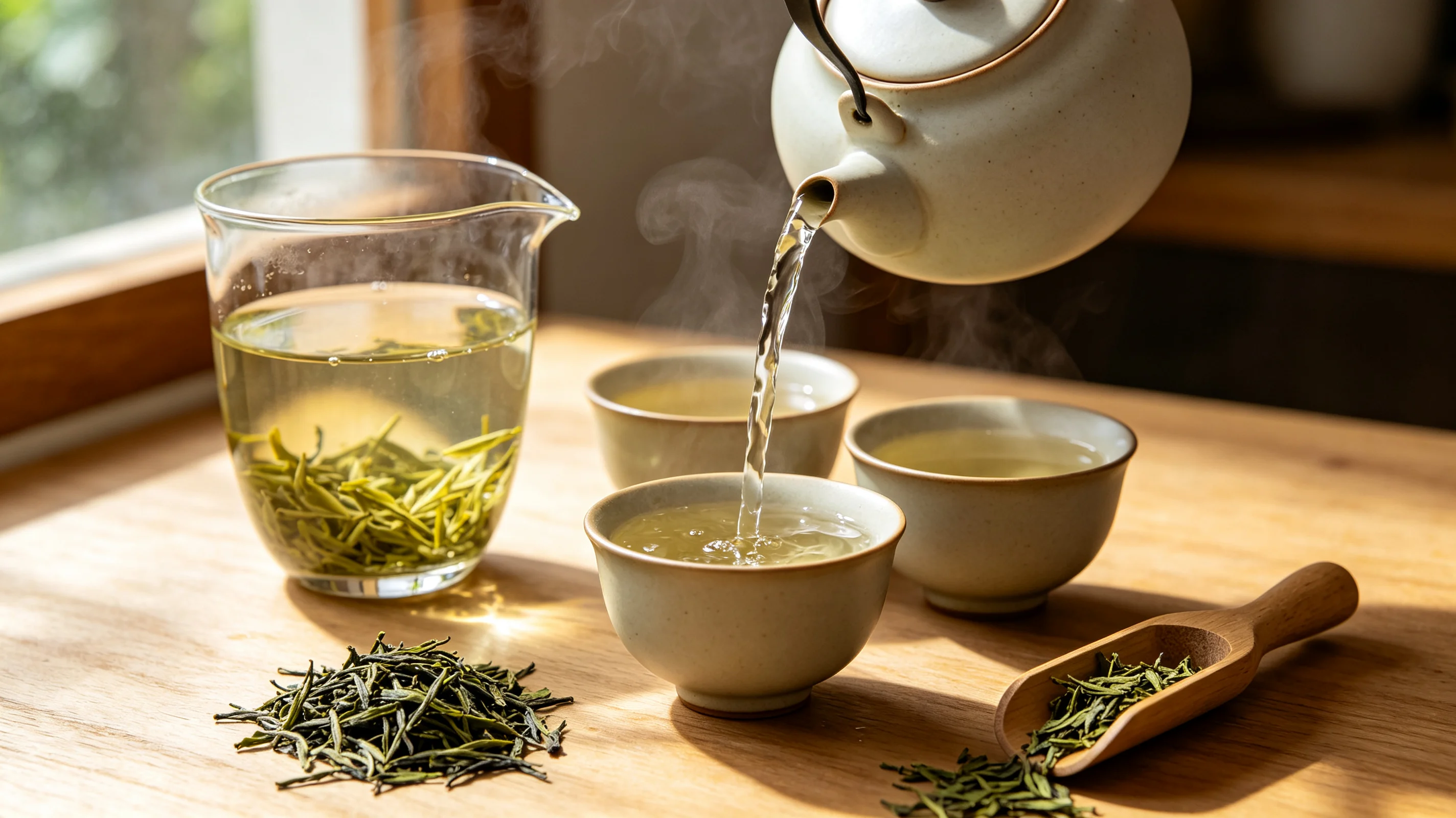
Tea water temperature without thermometer becomes manageable when the cooling method is consistent and the cup provides feedback.
You can control tea water temperature without a thermometer by using time, vessel transfers, and the behavior of the water. The method will not produce laboratory precision, but tea rarely needs that level of exactness for a good daily cup.
The most reliable home approach is to boil fresh water, then cool it deliberately rather than guessing while the kettle heats.
A Practical Temperature Range
| Tea style | Useful starting range | Simple approach |
|---|---|---|
| Delicate green tea | About 70–80°C / 158–176°F | Let boiled water rest or transfer twice |
| White tea | About 75–90°C / 167–194°F | Cool briefly; adjust by leaf style |
| Light oolong | About 85–95°C / 185–203°F | Short rest after boiling |
| Black tea | About 90–100°C / 194–212°F | Near boiling |
| Pu’er and herbal tea | Often near boiling | Use freshly boiled water |
Use the Vessel-Transfer Method
Pour boiled water into an empty cup or pitcher, then into the brewing vessel. Each transfer releases heat. One transfer is useful for oolong or delicate black tea; two transfers can bring the water closer to a green-tea range.
Use Resting Time
After boiling, open the kettle and wait. A short rest lowers the temperature, but the exact change depends on kettle material, water volume, room temperature, and whether the lid remains closed. Treat timing as a repeatable household method rather than a universal formula.
A related practical guide is Tea Aroma Guide: Why Fragrance Changes as Tea Cools.
Look at the Water, but Do Not Overtrust Bubbles
Small bubbles often appear before a full boil, while vigorous rolling bubbles indicate boiling. Bubble stages can help when heating water on a stove, but different pans and surfaces make visual rules imperfect.
Let Taste Correct the Estimate
- Tea is bitter and sharp: cool the water more next time.
- Tea is thin and closed: use slightly hotter water or more leaf.
- Aroma is clear but body is weak: adjust leaf amount before using boiling water.
- Leaves remain tightly rolled: try hotter water or a longer controlled steep.
For a complete view of water quality as well as temperature, use the best water for tea guide.
Preheat or Do Not Preheat?
Preheating a teapot reduces heat loss and makes the effective brewing temperature higher. If a green tea is repeatedly too harsh, skip preheating or cool the water more. For pu’er or roasted oolong, a warm vessel can help maintain heat.
Room Conditions Change the Cooling Rate
A metal kettle in a cold kitchen loses heat differently from a full insulated kettle in summer. A tiny porcelain pitcher also cools water faster than a large heavy pot. This is why universal claims such as wait exactly five minutes can fail in another home.
Create your own reference with one familiar green tea. Repeat the same water volume, kettle, and transfer method. When the tea becomes consistently smooth, the routine is more useful than an estimated number borrowed from a chart.
- Keep kettle volume similar.
- Use the same receiving cup.
- Adjust one transfer or one minute at a time.
Build One Repeatable Routine
Use the same kettle, water volume, waiting time, and cup transfer for a familiar tea. Once the result is stable, small adjustments become easy. Consistency matters more than pretending an estimated temperature is exact.
A Side-by-Side Example
Boil water, pour it into an empty pitcher, wait briefly, then transfer it to the brewing cup. If the green tea remains bitter, add another transfer next time. Once the cup becomes balanced, repeat the same sequence rather than guessing a temperature.
Tea Water Temperature without Thermometer: A Practical Framework
Cooling time charts are only estimates because kettle material, water volume, room temperature, altitude, lid position, and vessel temperature all matter. Your own repeatable transfer method is more useful than a borrowed number treated as exact.
Preheating changes the effective brew. The same water poured into a cold mug cools faster than water poured into a warmed porcelain pot. When a delicate tea is consistently harsh, test the vessel as well as the kettle.
How to Verify the Advice in Your Own Kitchen
Test the complete workflow for tea water temperature without thermometer: prepare the water, measure the leaf, brew, pour, remove the leaves, handle drips, and clean the equipment. A setup that looks simple can fail at the moment an infuser has nowhere to rest or wet leaves cannot be discarded.
Build the first test around “Use the same kettle and water volume.” and “Cool by resting or vessel transfer..” Then remove any object or step that does not improve control, comfort, or cleanup. The best routine is not the most elaborate one; it is the one you can repeat without hesitation.
After several sessions, notice where attention is actually required. A timer may matter more than another cup, and a stable tray may matter more than decorative accessories. Spend effort on the point where the routine normally breaks down.
- Use the same kettle and water volume. Record what changed before moving to the next variable.
- Cool by resting or vessel transfer. Record what changed before moving to the next variable.
- Account for a preheated vessel. Record what changed before moving to the next variable.
- Let taste correct the estimate. Record what changed before moving to the next variable.
This verification step keeps tea water temperature without thermometer tied to a real result rather than a rule copied from another kitchen, product page, or tea table.
What This Guide Cannot Decide for You
Tea Water Temperature without Thermometer should fit the equipment, time, storage, and attention available in ordinary life. A method that works only under ideal conditions may still be interesting, but it should not be presented as the only correct routine.
Use “Use the same kettle and water volume.” and “Cool by resting or vessel transfer.” to identify the non-negotiable requirements. Everything else can be simplified until the process is comfortable and repeatable.
- Keep: the parts of tea water temperature without thermometer that produce a repeatable improvement.
- Recheck: results that appeared only once or under unusual conditions.
- Adapt: vessel size, water, timing, and serving to the actual situation.
- Stop: when safety, contamination, or damaged equipment becomes the concern.
Test the full workflow once before relying on it
Set up the equipment, brew, pour, remove the leaves, dispose of them, and clean everything. A practical method must work through cleanup, not only through the attractive moment of pouring.
Adjust the setup to the smallest number of pieces that solve the real problem.
Five Checks That Prevent Guessing
- Use the same kettle and water volume.
- Cool by resting or vessel transfer.
- Account for a preheated vessel.
- Let taste correct the estimate.
- Write down the successful routine.
Let the Cup Confirm the Rule
The best approach to tea water temperature without thermometer is the one that remains clear after the marketing language is removed.
For practical follow-up: loose leaf tea collection.