

What Is Loose Leaf Tea? How It Differs from Tea Bags
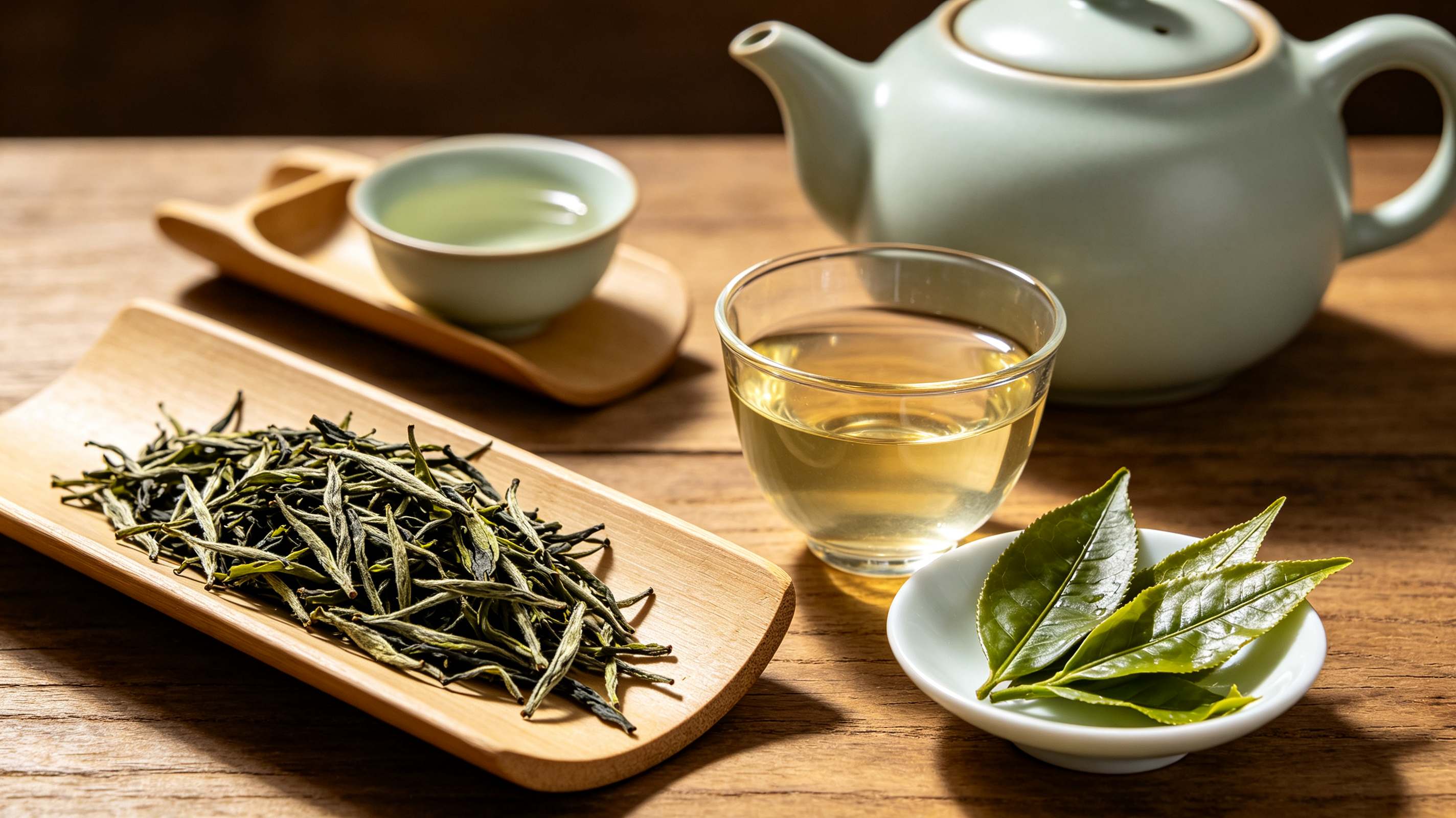
What is loose leaf tea? Loose leaf tea is tea sold as free, unbagged leaves rather than sealed inside individual tea bags. The leaves may be whole, partially broken, rolled, twisted, compressed or shaped depending on the tea and the way it was processed.
The term describes the form in which the tea is sold, not one particular type of tea. Green tea, black tea, white tea, oolong and pu-erh can all be sold as loose leaf tea.
What makes loose leaf tea different in practice is that the leaves usually have more room to expand during brewing, and the drinker has greater control over how much tea is used, how long it steeps and how many times the leaves are infused.
What Is Loose Leaf Tea Made From?
Most traditional true teas come from the plant Camellia sinensis.
The same plant can produce green, black, white, oolong and other styles of tea. The differences come from factors such as cultivar, growing conditions, harvest timing and processing.
Loose leaf tea is therefore not a separate plant or tea species. It simply means that the processed leaves are supplied loose instead of being portioned into conventional tea bags.
Herbal and fruit infusions can also be sold loose, although technically ingredients such as chamomile, peppermint or dried fruit are not true tea unless they contain leaves from Camellia sinensis.
Loose Leaf Tea vs Tea Bags
The most obvious difference between loose leaf tea and tea bags is how the tea is packaged.
A conventional tea bag contains a fixed quantity of tea enclosed in filter material. Loose leaf tea allows you to measure the tea yourself and place it directly into a teapot, gaiwan, infuser or brewing basket.
There can also be differences in leaf size.
Many mass-market tea bags use relatively small particles because they infuse quickly. Loose leaf products are more likely to include larger pieces or whole leaves, although this is not a universal rule.
| Feature | Loose Leaf Tea | Tea Bags |
|---|---|---|
| Leaf form | Often whole or larger pieces | Often smaller or broken particles |
| Portion control | You choose the amount | Usually pre-portioned |
| Brewing space | Can expand freely in a suitable infuser | Limited by bag size |
| Multiple infusions | Common with many teas | Less common |
| Convenience | Requires measuring and cleanup | Very convenient |
Tea bags are not automatically bad tea, and loose leaf tea is not automatically excellent tea. Quality still depends on the leaf, processing, freshness and sourcing.
Is Loose Leaf Tea Better Than Tea Bags?
It can be, but the packaging format alone does not guarantee quality.
Good loose leaf tea often has an advantage because larger leaves can retain more of their original structure and may develop gradually during brewing. They also have more room to open when placed in a spacious infuser or teapot.
However, poorly stored, stale or low-quality loose leaf tea can still taste worse than a well-made tea bag.
The better question is whether the tea itself is good and whether it has been stored and brewed appropriately.
Look at the leaves, smell the dry tea and pay attention to how the tea develops over multiple infusions rather than judging quality only by whether it came loose or in a bag.
What Types of Loose Leaf Tea Are There?
Almost every major tea category can be sold as loose leaf tea.
Green Tea
Green tea is processed to limit oxidation and is often associated with fresh, vegetal, grassy, nutty or lightly sweet characteristics depending on the style.
It is usually brewed with water below boiling because excessively hot water can make some green teas taste unnecessarily bitter or harsh.
You can browse our green tea collection or read our guide to brewing green tea without bitterness.
Black Tea
Black tea undergoes more extensive oxidation than green tea and typically produces a darker liquor with stronger malt, fruit, honey, spice or roasted notes depending on origin and processing.
Many black teas work well with hotter water and somewhat longer infusion times.
Our black tea brewing guide explains how to adjust temperature and steeping time.
Oolong Tea
Oolong covers a particularly broad range of styles, from lightly oxidized floral teas to darker roasted teas.
The leaves are often rolled or twisted and may expand dramatically during brewing, making adequate brewing space especially useful.
White Tea
White tea is usually minimally processed and may contain buds, young leaves or larger mature leaves depending on the style.
Its appearance can be delicate, but some white teas can handle surprisingly long steeping and repeated infusions.
Pu-erh Tea
Pu-erh is often associated with Yunnan and may be sold loose or compressed into cakes, bricks and other shapes.
Compressed tea is not technically loose when you buy it, but once a portion is separated for brewing, it is prepared in much the same way as other whole-leaf teas.
Does Loose Leaf Tea Taste Different?
Often, yes—but not simply because it is loose.
Leaf size, processing and brewing space can affect the way flavor develops.
Larger leaves may release aroma and flavor over a longer period, while very small particles tend to extract quickly. This is one reason broken tea can become strong or astringent faster than many whole-leaf teas.
Loose tea also gives you much more control.
You can change the leaf quantity, water temperature and steeping time instead of being limited to the fixed portion inside a tea bag.
That ability to adjust the recipe is one of the biggest practical advantages of loose leaf brewing.
How Much Loose Leaf Tea Should You Use?
A useful starting point for Western-style brewing is roughly 2 to 3 grams of tea for about 240 milliliters or 8 ounces of water, although the correct amount varies widely by tea type and leaf shape.
Large, fluffy white tea leaves take up far more physical space than tightly rolled oolong, so measuring only with teaspoons can be misleading.
A small digital scale is the most consistent method if you want repeatable results.
For a more detailed reference, see our guide to how much loose leaf tea per cup.
How Do You Brew Loose Leaf Tea?
Brewing loose leaf tea does not have to be complicated.
At minimum, you need tea, water, a vessel and some way to separate the leaves from the finished drink.
- Measure an appropriate amount of tea.
- Heat fresh water to a temperature suitable for the tea.
- Place the leaves in a teapot, gaiwan or spacious infuser.
- Add water.
- Steep for the appropriate amount of time.
- Separate the leaves from the liquor before the tea becomes over-extracted.
- Taste and adjust the next infusion if necessary.
There is no single correct brewing formula for every loose leaf tea.
If you are currently learning timing, our guide to how long to steep loose leaf tea provides starting ranges for green, black, white, oolong and pu-erh.
Do You Need a Special Teapot?
No.
One of the easiest ways to begin is with a large basket infuser placed inside an ordinary mug.
The important part is giving the leaves enough space to open while still allowing you to remove them cleanly when the infusion is ready.
A very small infuser packed tightly with large leaves can restrict expansion and make brewing less even.
If you are deciding between common brewing accessories, our article on tea infusers and tea strainers explains what each tool actually does.
Can Loose Leaf Tea Be Steeped More Than Once?
Many loose leaf teas can.
Oolong, white tea, pu-erh and many whole-leaf green and black teas can produce more than one enjoyable infusion.
The second cup will not necessarily taste identical to the first. In fact, part of the appeal of whole-leaf tea is observing how aroma, texture and flavor change from one infusion to the next.
Rolled tea may become more expressive after the leaves fully open, while later infusions often become lighter and require a little more time.
How many times a tea can be brewed depends on leaf quality, quantity, brewing method and personal taste.
Does Loose Leaf Tea Contain Caffeine?
If the loose leaf tea comes from Camellia sinensis, then it naturally contains caffeine.
Green, black, white and oolong teas all contain caffeine, although the amount varies according to the leaf and brewing method.
Loose leaf tea is therefore not inherently lower or higher in caffeine simply because the leaves are sold loose.
The amount of leaf, water temperature and infusion time all influence the final cup.
How Should Loose Leaf Tea Be Stored?
Tea generally keeps best when protected from moisture, strong odors, light, heat and unnecessary exposure to air.
A clean, well-sealed container stored in a cool, dry place is suitable for many teas.
Do not place tea next to spices, coffee or strongly scented foods simply because everything fits on the same shelf. Dry tea can absorb surrounding odors surprisingly easily.
Different teas also age differently. Fresh green tea and deliberately aged pu-erh should not automatically be treated as though they have identical storage needs.
How Can You Tell Whether Loose Leaf Tea Is Good Quality?
There is no single visual test that proves a tea is good.
Expensive tea is not always made entirely from perfect-looking leaves, and broken leaves do not automatically mean poor quality.
A more useful assessment considers several things together:
- Does the dry tea smell clean and characteristic of its style?
- Are there signs of moisture, mold or foreign odors?
- Does the brewed tea have a clear, recognizable aroma?
- Does the flavor feel balanced rather than simply strong?
- Does the tea remain interesting across more than one infusion?
- Does the seller provide useful information about the tea rather than relying only on marketing terms?
Ultimately, the cup matters more than whether every leaf looks identical.
Is Loose Leaf Tea Difficult for Beginners?
Not really.
Loose leaf tea sometimes appears complicated because tea enthusiasts discuss grams, water chemistry, gaiwans, multiple infusions and precise temperatures.
None of those things are required to make a decent first cup.
A mug, basket infuser, fresh water and a basic timer are enough to begin.
Once you understand the relationship between tea quantity, water temperature and steeping time, you can gradually experiment with more specialized brewing methods if they interest you.
Frequently Asked Questions About Loose Leaf Tea
What is loose leaf tea in simple terms?
Loose leaf tea is tea sold as free leaves rather than sealed in individual tea bags. You measure the amount yourself and brew the leaves in a teapot, infuser, gaiwan or other vessel.
Can I put loose leaf tea directly into a cup?
Yes. You can place the leaves directly into a cup, although you will either need to drink around them or strain the tea before drinking. A basket infuser usually makes the process easier.
Is loose leaf tea stronger than tea bags?
Not automatically. Because you control the amount of loose tea, you can make the cup lighter or stronger. Tea bags contain a fixed quantity, while loose leaf brewing gives you more control over the recipe.
Can you drink loose tea leaves?
Small pieces of tea leaf are generally not a problem if they enter the cup, but loose leaf tea is normally infused and then separated from the liquid rather than eaten as part of the drink.
Is loose leaf tea worth buying?
For people who enjoy experimenting with different teas and brewing styles, loose leaf tea offers considerably more choice and control. Whether it is worth buying ultimately depends on the quality of the tea and how much you value that flexibility.
Loose Leaf Tea Is More About Control Than Complexity
So, what is loose leaf tea? At its simplest, it is tea sold without individual tea bags. But the practical difference goes further than packaging.
Loose leaves give you control over how much tea you use, how much space the leaves have to open, how long they brew and whether you want to steep them again.
You do not need elaborate equipment or expert knowledge to start. A good tea, suitable water and a simple infuser are enough.
Once you understand the basics, loose leaf tea becomes less complicated—not more—because you can adjust the cup to suit the tea and your own taste.
You can explore Teazenway’s loose leaf tea collection to compare different styles and discover which teas suit the way you prefer to brew.